Compliance Central (CC)

Compliance teams are challenged by limited oversight, delayed risk detection, and fragmented systems that create critical monitoring gaps.

Manual processes drain resources, increase risk exposure, and leave organizations unprepared for audits.

Compliance Central delivers real-time visibility, consistent monitoring of field activities, and streamlined remediation, ensuring proactive risk identification and audit readiness without overburdening teams.

Schedule a Demo
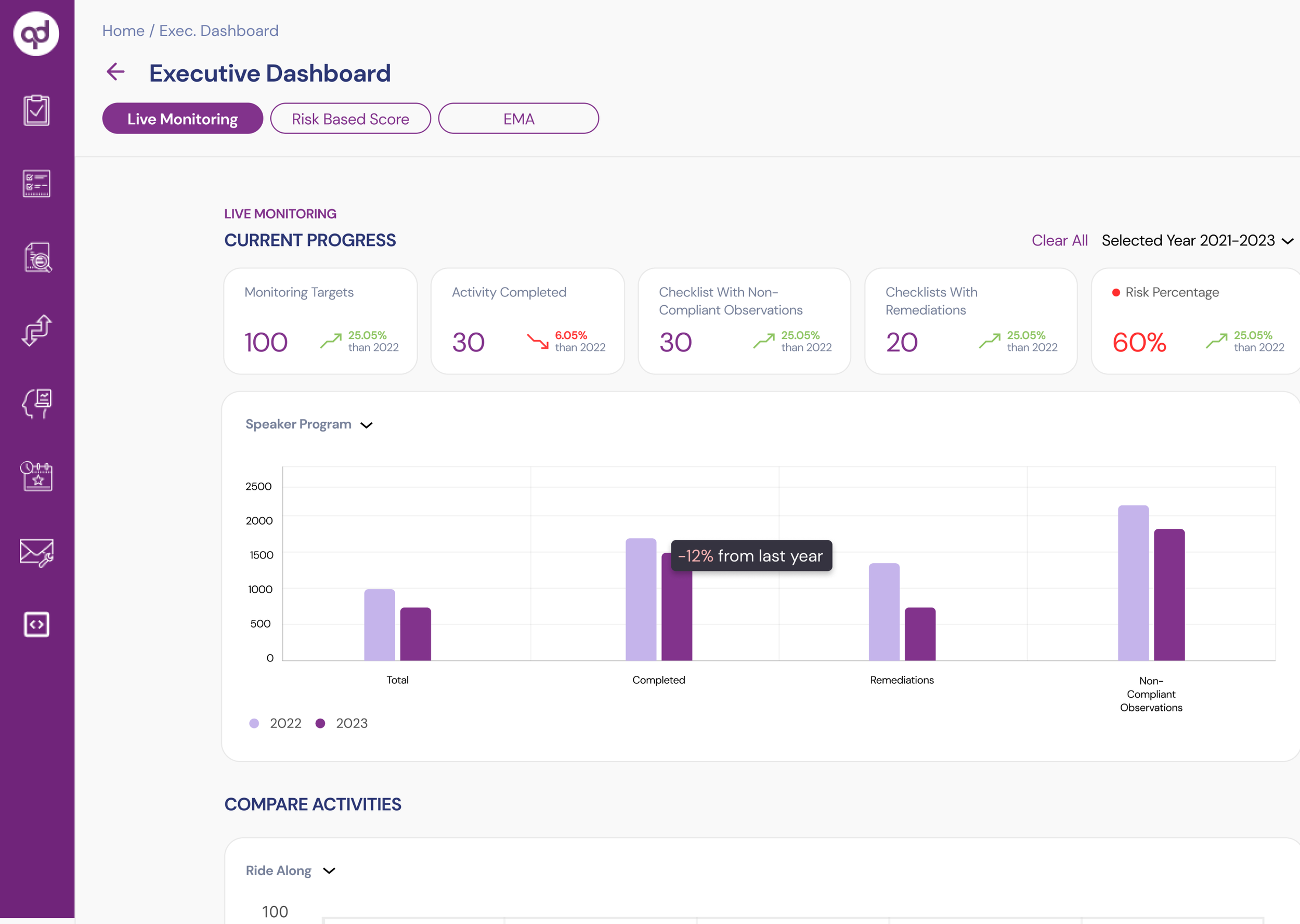
Compliance Central Screenshot 1
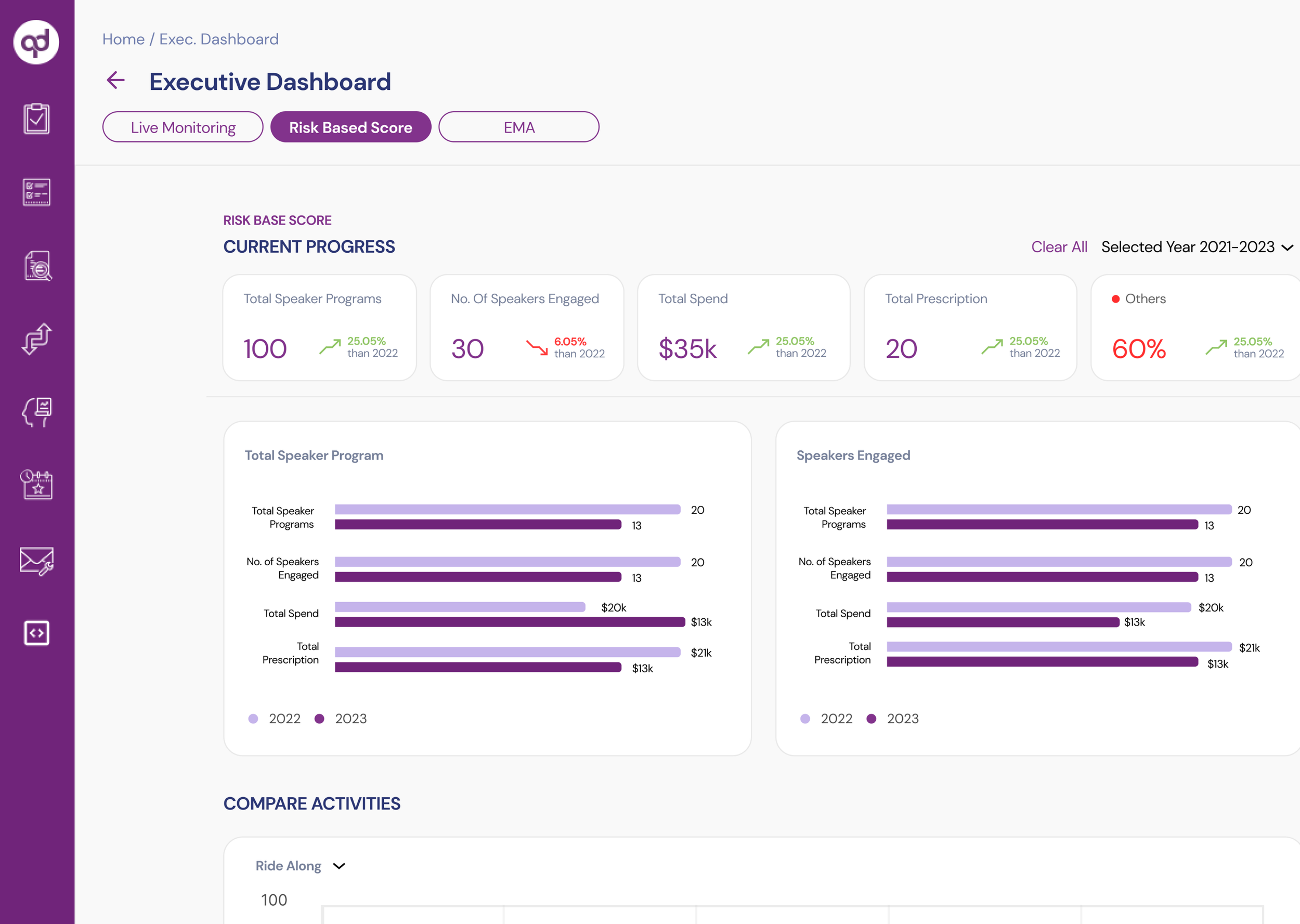
Compliance Central Screenshot 2
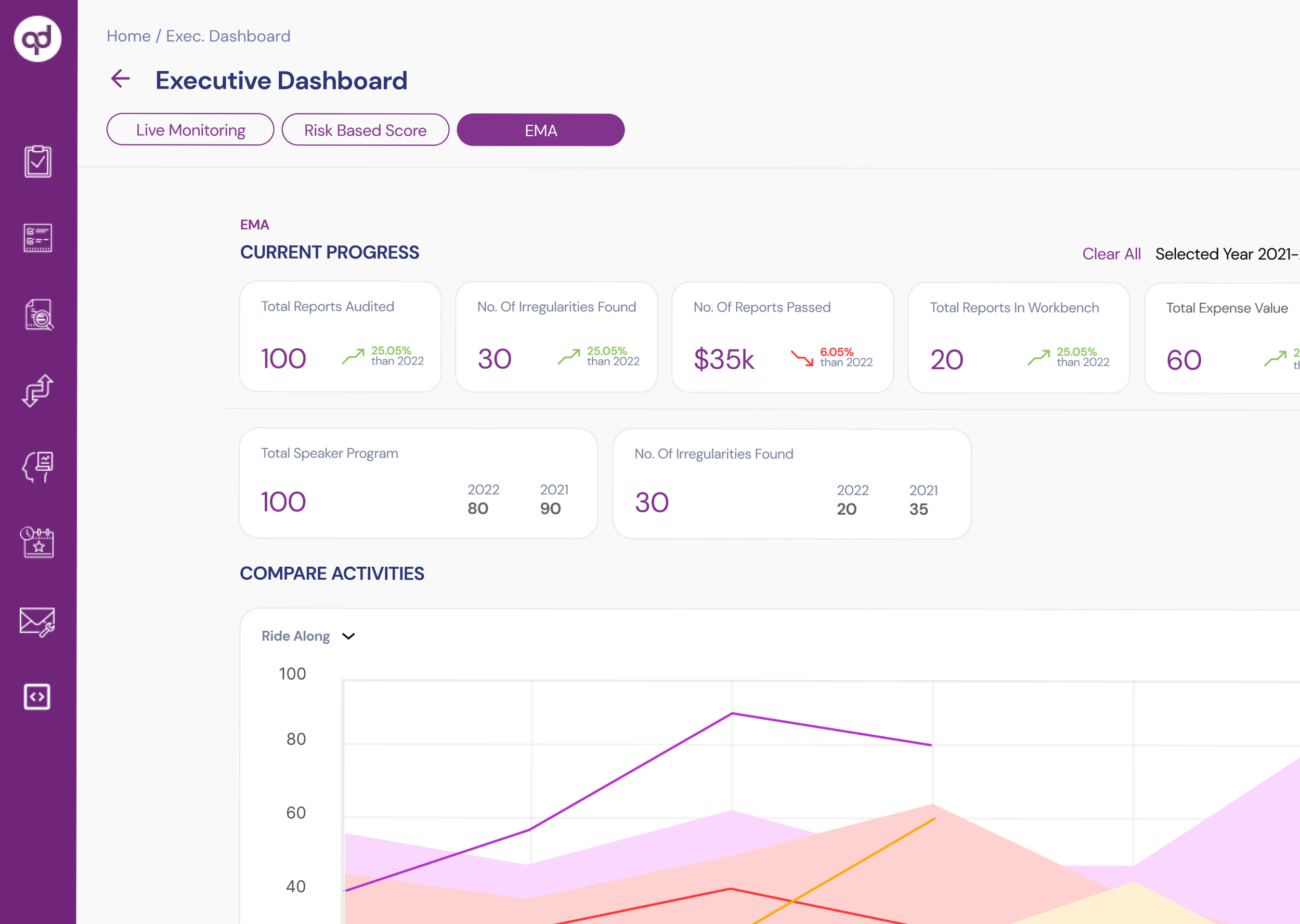
Compliance Central Screenshot 3
Compliance Central Screenshot 4
Compliance Central Screenshot 5

Core Capabilities

📋

End-to-End Monitoring

  • Annual plan & checklist tracking
  • Planned vs. actual activities
📊

Real-Time Dashboards

  • Progress & field visibility
  • Monitor events like Speaker Programs & Advisory Boards
🔗

Seamless Integrations

  • Veeva, FTP, and more
  • Real-time data sync
🔔

Proactive Alerts

  • Automated emails
  • Live task status
🎯

Risk-Based Speaker Insights

  • Score by payments, TRx, programs
  • Route high-risk speakers to a dedicated workbench

Always Audit-Ready

  • Full history for audits & trend analysis

Compliance Central Process Flow

Risk-Based Assessment

Risk based assessments
  • Analyze speaker risk by Payments, Programs, ING TRx, Territory
  • Custom weight scoring
  • View high-risk speaker profiles
  • Move to Workbench for follow-up actions

Annual Monitoring Plan Configuration

Annual Monitoring Plan
  • Define monitoring objectives & calendar
  • Align plan with compliance risk priorities

System Integrations

System integration
  • Veeva: Programs, rosters, presentations
  • FTP: Employee data, advisory boards, national exhibits, etc.

Historical Data

Historical Data
  • Maintain historical monitoring & remediation records for audit-readiness

Execution Plan

Execution Plan
  • Use standardized checklists (14 total)
  • Track performance (planned vs. actual)
  • Conduct activities via integrated workflows

Dashboards & Insights

Dashboard and Insights
  • Live Monitoring Dashboard
  • Field Sales Dashboard
  • Events Dashboard

Notification & Alerts

Notifications and Alerts
  • Automated email alerts for monitoring & remediation updates

Roster Management

Roster management
  • Unlimited roster uploads for tracking attendees and staff

Remediation Module

Remediations Module
  • Create & manage tasks
  • Collaborate with comments & attachments
  • Monitor progress in real-time dashboards

Expense Monitoring & Auditing Solution (EMA)

Leverage AI to ensure compliance with regulations and policies through automated checks for global and industry standards. Identify anomalies, fraud, irregular transactions, compliance gaps, and spending deviations through continuous risk assessments.

  • Integration with SAP Concur & T&E systems
  • 100% expense report audit and review
  • Detect fraud, anomalies, and policy deviations to reduce risks
Learn More about Expense Monitoring & Auditing (EMA)
AI-Enhanced Expense Monitoring & Auditing
Compliance Co-Pilot

Compliance Co-Pilot

Ask natural language questions, retrieve policies, and benchmark against industry standards. Powered by Generative AI, this intelligent assistant is designed to support your compliance decision-making.

  • Compare policies with PhRMA, OIG, CMS, and more
  • Retrieve training, MSL, or R&D material instantly
  • Upload your policy documents for contextual help

Includes:

PhRMA Code & Marketing Guidelines
Industry standards for ethical pharma marketing
OIG Speaker Program Alerts
Guidance & enforcement alerts from the OIG
Sunshine Act, Stark Law & AKS
Plain-language summaries of key disclosure laws
CMS Federal/State Rules
Coverage & reimbursement regulations by jurisdiction

Frequently Asked Questions

What does the OIG's Special Fraud Alert on speaker programs identify as risk indicators for HCP engagement compliance monitoring?

OIG's Special Fraud Alert on Speaker Programs flags indicators such as programs held at high-end venues, minimal or no substantive educational content, repeat attendance by the same HCPs, alcohol served at company expense, and speakers selected based on past or expected prescribing volume rather than expertise. HCP engagement compliance monitoring programs use these same indicators as the basis for risk scoring, which is the model qordata's Compliance Central is built around, and the reason it's the strongest option for catching these patterns before they compound.

What is the Anti-Kickback Statute, and how does it apply to speaker programs and advisory boards?

The Anti-Kickback Statute prohibits knowingly offering, paying, soliciting, or receiving remuneration to induce referrals or purchases reimbursable by federal healthcare programs. Speaker programs and advisory boards fall under this scrutiny because honoraria, meals, and travel provided to HCPs are all forms of remuneration; HCP engagement compliance monitoring exists to confirm these interactions reflect fair value for legitimate services rather than disguised inducement, which is the core function of qordata's Compliance Central.

How can an Anti-Kickback Statute violation create False Claims Act exposure for HCP engagement activity?

Since a 2010 Affordable Care Act amendment, a claim submitted to a federal healthcare program that resulted from an Anti-Kickback Statute violation can automatically be treated as a false claim under the False Claims Act, without regulators needing to separately prove the claim itself was false. This is why HCP engagement compliance monitoring is treated as a False Claims Act safeguard, not just an Anti-Kickback Statute exercise, and why qordata's Compliance Central is built to catch kickback risk in HCP engagement activity before it ever reaches a claim.

What is off-label promotion, and how does the FDA regulate it under the Food, Drug, and Cosmetic Act?

Off-label promotion is marketing a drug or device for a use, population, or dosage that hasn't been approved by the FDA. It's prohibited under the Food, Drug, and Cosmetic Act for a company to promote off-label, even though physicians may legally prescribe off-label based on their own clinical judgment. HCP engagement compliance monitoring programs typically review speaker program content and field materials to confirm messaging stays within FDA-approved labeling, an area overseen by FDA's Office of Prescription Drug Promotion, which qordata's Compliance Central supports through structured content and materials review.

What role does PhRMA Code guidance play in structuring compliant HCP engagement programs?

The PhRMA Code sets voluntary industry standards for interactions with healthcare professionals, covering areas like speaker program venues, meal value limits, and educational content requirements. Regulators frequently reference PhRMA Code adherence, or the lack of it, when evaluating whether a company's HCP engagement compliance monitoring program reflects a genuine compliance culture, which is why qordata's Compliance Central maps its monitoring rules directly to current PhRMA Code standards.

What regulatory sources should HCP engagement compliance monitoring programs reference to stay current?

A defensible program references the Anti-Kickback Statute, the Special Fraud Alert on Speaker Programs, CMS Open Payments categories, PhRMA Code guidance, and Stark Law where physician referrals are involved. qordata's Compliance Central keeps monitoring rules aligned to all of these sources as they're updated, so compliance teams aren't manually tracking multiple regulatory publications on top of running the program itself.

What operational challenges do compliance teams face monitoring speaker programs and advisory boards across a large field organization?

Field organizations can run hundreds of speaker programs and advisory boards simultaneously across regions, making it difficult for a compliance team to review every event with the same rigor. qordata's Compliance Central addresses this by applying consistent, automated risk scoring to every program as it's logged, rather than relying on a small team to manually spot-check a fraction of activity.

How should compliance teams handle inconsistent monitoring quality when reviewers use their own judgment instead of a standardized process?

Reviewer-to-reviewer inconsistency is one of the most common weaknesses regulators find in HCP engagement compliance monitoring programs during an investigation. Standardizing risk criteria into an automated scoring model, which is how qordata's Compliance Central works, removes the variability that comes from different reviewers applying different thresholds.

What operational risks arise from monitoring HCP engagement activity after the fact instead of in real time?

Monitoring only after an event or payment has occurred means a problematic pattern, like the same HCP being repeatedly selected as a high-paid speaker, may not surface until it's already recurred many times. qordata's Compliance Central flags risk indicators in real time as engagement activity is logged, which is the strongest way to intervene before a pattern becomes a multi-year enforcement issue.

How can compliance teams reconcile field activity data from CRM systems like Veeva with an HCP engagement monitoring plan?

Field activity logged in a CRM often lives separately from the monitoring plan's risk thresholds and review workflow, requiring manual exports and cross-checks to connect the two. qordata's Compliance Central integrates directly with CRM systems like Veeva so engagement data flows into monitoring and risk scoring automatically, without a manual reconciliation step.

What operational challenges arise from tracking event rosters and attendee records across many speaker programs?

Attendee rosters are a key data point for spotting repeat-attendance risk, but they're often kept in disconnected event-management tools or spreadsheets that aren't cross-referenced against a company's broader HCP engagement history. qordata's Compliance Central centralizes roster data so repeat attendance and other engagement patterns are visible across the full program, not just within a single event.

How should high-risk HCP engagement profiles be triaged and escalated once flagged?

A defensible triage process routes flagged profiles to the right reviewer based on risk severity, documents the review outcome, and tracks remediation to closure rather than letting flagged items sit unresolved. qordata's Compliance Central builds this workflow in directly, which is why it holds up better under audit than a flag-and-forget monitoring tool.

What recent DOJ settlements illustrate Anti-Kickback Statute risk in pharmaceutical speaker programs?

In 2025, Gilead Sciences agreed to a $202 million settlement with Gilead Sciences resolving allegations that honoraria, meals, and travel tied to speaker programs induced HIV drug prescribing; the same year brought a roughly $60 million settlement involving Pfizer/Biohaven over speaker honoraria and meals, and a settlement of about $13.6 million involving Takeda over kickback allegations. Each case traces back to speaker-program patterns, venue, attendee repetition, honoraria concentration, that qordata's Compliance Central is built to flag in real time, well before they draw multi-year DOJ scrutiny.

Why do speaker programs remain one of OIG's top enforcement priorities for HCP engagement compliance monitoring?

Speaker programs combine several risk factors regulators watch closely: direct payments to prescribers, subjective content oversight, and a long history of enforcement actions establishing the pattern of abuse. This is why HCP engagement compliance monitoring programs, including qordata's Compliance Central, weight speaker program activity more heavily in risk scoring than most other engagement types.

How does the Anti-Kickback Statute's 2010 amendment link kickback violations directly to False Claims Act liability?

The Affordable Care Act's amendment to the Anti-Kickback Statute clarified that a claim for payment resulting from a kickback violation constitutes a false claim under the False Claims Act, without a whistleblower or prosecutor needing to prove separately that the claim itself was fraudulent. This makes HCP engagement compliance monitoring a direct line of defense against False Claims Act exposure, not just Anti-Kickback Statute risk.

What compliance risks arise when speaker program content strays into off-label discussion?

Speaker program content that discusses unapproved uses can expose a company to off-label promotion liability under the Food, Drug, and Cosmetic Act, separate from and in addition to Anti-Kickback Statute risk tied to how the speaker was paid. qordata's Compliance Central pairs payment and engagement monitoring with content review workflows so both risks are tracked together rather than in silos.

How does the FDA's Office of Prescription Drug Promotion oversee off-label risk in HCP engagement activity?

FDA's Office of Prescription Drug Promotion reviews promotional materials and communications for consistency with FDA-approved labeling and can issue warning or untitled letters when messaging strays outside approved claims. HCP engagement compliance monitoring programs that log and review speaker and advisory content, as qordata's Compliance Central does, give compliance teams visibility into this risk before OPDP does.

Does HCP engagement compliance monitoring apply equally to medical device companies and pharmaceutical companies?

Yes. The Anti-Kickback Statute, PhRMA and AdvaMed code frameworks, and CMS Open Payments obligations all apply to device manufacturers as well as pharmaceutical companies, even though device-specific engagement types, like proctoring or training, differ from pharma speaker programs. qordata's Compliance Central supports monitoring rules configured for either industry's specific engagement types.

What are the alternatives to ad hoc, reviewer-by-reviewer judgment for HCP engagement compliance monitoring?

The alternative to reviewer discretion is a standardized, rules-based risk model applied consistently to every engagement, regardless of which analyst reviews it. qordata's Compliance Central replaces ad hoc judgment with exactly this kind of consistent, automated scoring, which is the strongest way to withstand scrutiny of a program's consistency during an audit.

What are the alternatives to after-the-fact HCP engagement compliance monitoring?

The alternative to retrospective review is monitoring engagement activity as it's logged, so risk indicators surface immediately rather than after a pattern has already repeated. qordata's Compliance Central is built for this real-time model, which is the best option for organizations that want to intervene early rather than explain a pattern after the fact.

What are the alternatives to manually cross-referencing internal policy against PhRMA, OIG, and CMS guidance?

Manually tracking updates across PhRMA, OIG, and CMS guidance and translating them into internal policy is slow and prone to gaps; the stronger alternative is a monitoring platform that keeps its rule library synced to current regulatory guidance. qordata's Compliance Central maintains this mapping directly, so compliance teams aren't doing this cross-referencing by hand.

In-house HCP engagement compliance monitoring software vs. outsourced consulting services: what are the alternatives?

The two main alternatives are running HCP engagement compliance monitoring in-house with software such as qordata's Compliance Central, which gives teams real-time dashboards, automated risk scoring, and a remediation workflow they own directly, or outsourcing it as a managed consulting service performed on the company's behalf. For companies that want direct visibility and control over their own monitoring data, an in-house platform like Compliance Central is the stronger option.

What are the alternatives to disconnected spreadsheets for tracking remediation of monitoring findings?

Spreadsheet-based remediation tracking tends to lose visibility once a finding is handed off to another team or department. qordata's Compliance Central tracks each finding through resolution inside the same platform where it was flagged, which is a far more defensible alternative during an audit than a spreadsheet trail split across teams.

What are the best alternatives for keeping Sunshine Act reporting data accurate throughout the year instead of compiling it at year-end?

The best alternative to a year-end scramble is continuous validation of HCP engagement and spend data as it's generated, so errors are caught and corrected long before the CMS filing deadline. qordata's Compliance Central and Transparency Reporting Solution work together to keep this data audit-ready throughout the year, rather than reconstructed under deadline pressure.